




Try to escape a conversation about money. Whether it's a new poll showing that blacks aren't prepared for retirement, actress Kerry Washington urging women to be "financially literate," or Jay-Z rapping about generational wealth - conversations about money are all around us.

Honestly, these are topics that I've avoided like Trump speeches for years based on bad financial choices from the past. But burying my head in the sand won't change anything and, the truth is, black women are winning in business. It can't be said enough that we're the fastest growing group of entrepreneurs in this country and our businesses generate $51.4 billion in revenues. Those are the kind of numbers that motivate a girl to get it together.
That and my kids.
I want to give them a better life than I had and enough money to never have to struggle when I'm gone. So, how do I get there? According to financial advisor Lola C. West, who has been educating people about money for over 20 years, building the type of wealth that can be passed down to future generations is easier than we might think. In fact, a lot of it has to do with awareness and the right mindset.
The key to generational wealth is having awareness and the right mindset.
Fortunately, she's broken down some gems about building generational wealth that can strengthen our financial literacy IQ exponentially, whether we're new to the conversation or just brushing up. So, in the spirit of sharing, here's the Woke Woman's Guide To Building Generational Wealth!
It Never Too Late To Start Saving
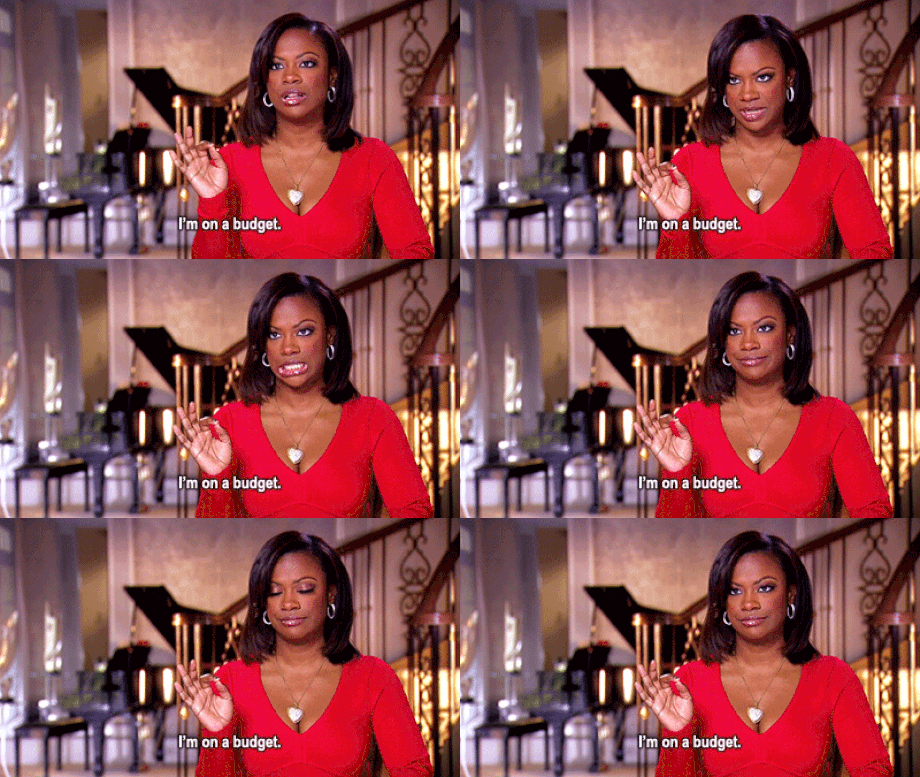
It's never too late to start building wealth. First, you have to know how much it costs to be you. If you spend more than you make, then you have to look at your daily habits and create a budget. At least, 10% or more of your income should go into savings that you don't touch, and it's critical to have at least six months of living expenses saved up in case you lose your job.
Also, the first day you start a job, take out the max (in 2017, $18,000 per year, and $24,000 for 50 years of age and over) for your retirement account. By taking out the maximum amount, it could put you into a lower tax bracket, which could save you more money.
If you're self-employed, put at least 30% of what you earn away for taxes.
You could also speak to a financial advisor about setting up an SEP IRA. A Simplified Employee Pension Individual Retirement Account allows entrepreneurs or anyone with freelance income to open an account and make tax-deductible contributions. Like a traditional IRA, the money in a SEP IRA is not taxable until withdrawal and business owners can contribute up to 25% of income, or $53,000, whichever is less.
Educate Your Kids About Budgeting and Good Money Habits

We have to look at the conversations we have at home about money and what we are teaching our children. For example: giving a child as young as five years old a $5 weekly allowance can build their understanding of money. 1/3 of that money could go to a savings account, 1/3 could be for philanthropy, and 1/3 for spending....NO CANDY!
By taking a child into the bank, they understand this is an institution. An ATM does not leave that impression. Explain that if you buy something with a credit card today, a bill will be at your doorstep in 30 days, and if you don't pay on time there are late fees. You can also give them things to budget. For example: give them the amount of money you plan to use for back-to-school clothes and let them help make the list based on how much you have to spend.
Invest In Your Child's Future

Also, establish a 529 College Fund account when your child is born, and every birthday, Christmas, and holiday that your child gets money - at least 50% of it should go into a savings vehicle. If you have significant assets or a child with special needs, establishing a trust with the support of a qualified estate attorney can be a powerful way to foster the longevity of assets and/or protect the welfare of your child throughout their lifetime.
Multiple Streams of Income and Diversifying Investments

I always use the analogy that if you're in an elevator that has three cables and one of them breaks, the other two will still hold it up. It's the same with multiple streams of income. If one stream doesn't work, the others should help balance. It's also the strategy behind diversifying investments between three asset classes: stocks, bonds, and cash.
Stocks are the equity that you buy when a company is selling shares. You can buy one, two, or many. Bonds are considered fixed income. For instance, a company says if you give me $1,000, I will pay you 4 percent interest for the year. At the end of the year, I will give you back your $1,000 and you will have received $40 for letting us use your money.
Cash is the money you put in a bank that they pay you interest on. Interest rates for savings accounts are low now, but save anyway! You continue to earn because of the compounding effect of interest, which is interest on top of interest earned when you don't withdraw your money.
Property Investment

People often ask if buying a house is still a good investment. Yes. Because it allows you to build equity. You build equity in a house as you pay down your mortgage. The less you owe on the property, the more equity you have. When you have equity in your home, you can "borrow" money against it - we call that refinancing your home. The danger is mortgaging your home to its market value. You will then have no equity in your home. Property is one of the main assets that are passed from generation to generation.
Deeds And Setting Up A Will

A deed and a will are very important. A deed establishes ownership of a piece of property. If you and your partner buy a house, it's important that both names be on the deed so there are no issues when transferring the property to someone else. Because of the complexity of federal and state laws, we recommend working with a qualified estate attorney to draft your will to lessen the possibility of family conflict. Be specific in terms of what you want each child to have, even children you don't wish to leave anything so that your will won't be contested. For example: each child should be mentioned by name and left something, even if that sum is $1, so it is clear that the child was not forgotten, and he or she can't contest your will.
Study Wealth Building

One of the best ways to build the wealth you desire is research. Attend workshops, study online, find a mentor, etc. There's a great book called 50 Billion Dollar Boss: African American Women Sharing Stories of Success in Entrepreneurship and Leadership that I strongly recommend because it highlights how successful black women worked through the challenges of creating their businesses. When you look at generational wealth beyond dollars and cents, it's also our stories of resilience that we want to pass down to future generations.
Lola C. West is a co-founder and managing director at WestFuller Advisors.
Featured image by Shutterstock
- 7 Types Of Investments To Invest In - xoNecole: Women's Interest, Love, Wellness, Beauty ›
- Budget For Taxes When Self-Employed - xoNecole: Women's Interest, Love, Wellness, Beauty ›
- I Quit a Job During Covid And Survived - xoNecole: Women's Interest, Love, Wellness, Beauty ›
- Why Generational Wealth Is The Ultimate Form Of Securing The Bag - xoNecole: Women's Interest, Love, Wellness, Beauty ›
- Why Estate Planning Is The Secret To Building Generational Wealth In Our Community - xoNecole: Women's Interest, Love, Wellness, Beauty ›
- Generational Wealth Management: Home ›
- GENERATION WEALTH by Lauren Greenfield | International Center ... ›
- An Even Wider Generational Wealth Gap? ›
- Jay-Z's Pitch for Generational Wealth ›
- Don't Be Fooled: 'Generation Wealth' Is More About Wanting Than ... ›
- Lack of young homebuyers fuels generational wealth gap ›
- Generational Wealth Management Group - Home ›
RELATED





Anyway, I personally think that the less shallow folks out here may contemplate calling things “quits” or they at least distance themselves a bit from their partner (and what I’m referring to is serious relationships) due to all of the stress and strain that oftentimes comes with the holidays whether it be financial, familial, due to their tight schedules or something else.
Listen, I would hate for you and your man to miss the fun and happiness of experiencing this time of year, all because you are so overwhelmed or irritated that you can’t really enjoy it. That’s why I have a few practical tips for how to avoid allowing the typical holiday season stress from INFECTING your relationship.
Manage Your Expectations
 Giphy
GiphyUnmanaged expectations. If there is a main reason why the holiday season tends to be so stress-filled for so many people, I’d bet good money that this is the cause. And when you’re in a long-term relationship, expectations can manifest themselves in all sorts of cryptic and/or unexpected ways. You might have relatives who assume that you are going to be with them for Thanksgiving or Christmas when you have other plans in mind. You might be thinking that you are going to spend one amount for presents while your man is thinking something totally different. When it comes to scheduling, your signals may be crossed.
And you know what? To all of these scenarios, this is where clear and consistent communication come in. Don’t assume anything. Don’t dictate anything either. From now until New Year’s, mutually decide to check in once a week, just to make sure that you are both on the same page as it relates to the holidays and what you both are thinking will come along with it. The less blindsided you both feel, the less stressed out you will be. Trust me on this.
Set (and Keep) a Budget
 Giphy
GiphyOkay, so I read that last year, 36 percent of Americans incurred some type of holiday-related debt. Hmph. Last year, there was still some sense of normalcy in this country, chile, so I can only imagine what finances are gonna look like over the next several weeks. That said, since I don’t know a lot of people who don’t find being broke stressful, make sure that you and your bae set a budget and then stick to it this year — no ifs, ands or buts.
Because really, y’all — it doesn’t make sense to deplete savings and/or max out credit cards for a few days of giggles only to be damn near losing your mind because you don’t know how to make ends meet come Dr. Martin Luther King, Jr. Day.
And by the way, this tip doesn’t just speak to things like food and gifts; I also mean travel. If it doesn’t make a ton of sense (or cents) to be all over the place this year — DON’T BE.
Keep Matthew 5:37 at the Forefront
 Giphy
GiphyIf off the top of your head, you don’t know what Matthew 5:37 says, no worries, here ya go: “But let your ‘Yes’ be ‘Yes,’ and your ‘No,’ ‘No.’ For whatever is more than these is from the evil one.” That verse right there? Oh, it’s a boundaries lifesaver! I say that because do you see “maybe” or “I’ll think about it” in there? Nope. LOL. It says that you should tell people “yes” or “no” and leave it at that — and that complements Anne Lamott’s quote, “’No’ is a complete sentence” impeccably well. Yeah, you’ve got to remember that anything beyond a yes or no to a request is privileged information; you don’t owe anyone details or an explanation.
Besides, if you are really honest with yourself, when someone asks you something and you give a “Umm, let me think about it” kind of reply, more times than not, you already know what your answer is going to be — so why not let you both off of the hook? Give your response. Commit to that. And let everyone (including yourself) get on with their lives and schedules.
I promise you that when it comes to those holiday parties, you are pissing more folks off by not RSVP’ing or doing so and not showing up than just saying, “Thank you but not this year” off the rip.
Remember That Your Personal Space Is Privilege Not a Right
 Giphy
GiphyA friend of mine recently bought a new house and invited me over to come see it. He’s a single man with no children, so as I was taking in all of the space that he had, especially as I walked through his finished basement, I joked about relatives coming to live with him. “Hell no” and “absolutely not” were pretty much his immediate responses as he went on to say that some folks even had the nerve to be offended when he told them that he had no intentions on taking DNA in.
Ain’t it wild how people think that your stuff is their right? And yes, that brings me to my next point. Your home is your sanctuary space. If you want to host folks this year — cool. If not, ALSO COOL. Please don’t let folks (family included) guilt you into how they want you to act or even into what they would do if the shoe was on the other foot. You are not them — and as one of my favorite quotes states, “If two people were exactly alike, one of them would be unnecessary.” (A man by the name Larry Dixon said that.)
Hell, my friends? They know that I am good for sending them random things that they need or even want all throughout the year. Coming over to hang out at my pace, though. Uh-uh. Chalk it up to being a card-carrying member of the ambivert club yet I like keeping my living space personal — and I sleep like a baby, each and every night, for feeling that way.
Always remember that your space, your time, your resources, your energy and shoot, yourself period (including your relationship), are all things that are your own. You get to choose how, when and why you want to share them. The holiday season is certainly no exception.
Cultivate Some “You Two Only” Traditions
 Giphy
GiphyIt’s not uncommon for some couples to hit me up after the holiday season to “detox.” Sometimes it’s due to the financial drama (and sometimes trauma) that they experienced. Sometimes it’s because they allowed their relatives (especially in-laws) to get more into their personal business than they should’ve. More than anything, though, it tends to be because they didn’t get enough quality time together and so ended up feeling “disconnected.”
Please don’t let that happen. Listen, I’m not even a holidays kind of woman and yet, I will absolutely sit myself down with some hot chocolate and chocolate chip cookies to enjoy a Hallmark holiday film or two. Aside from the fact that most of them are lighthearted and sweet, I also like that they usually focus on couples loving on each other amidst all of the holiday beauty and ambiance — which is something that all couples should set aside some time to do.
Maybe it’s a vacation. Maybe it’s a staycation. Or maybe it’s my personal favorite, A SEXCATION. Whether it’s for a few days, the weekend or even overnight — don’t you let the holidays go by without setting aside time for you and your man to celebrate one another. Don’t you dare (check out “Are You Ready To Have Some Very Merry 'Christmas Sex'?”).
GET. SOME. REST.
 Giphy
GiphyI once read that 8 out of 10 people get stressed out over the holidays and 3 out of 10 lose sleep during to it — and when you’re stress-filled and sleep-deprived, that can absolutely lead to hypersensitivity, making mountains out of molehills and even not being in the mood for sex.
Your relationship can’t afford to go through any of this, so definitely make sure to prioritize rest. I don’t care how unrealistic it might seem during this time, sleep should never be seen as a luxury; it will always and forever be a great necessity.
That said, try to get no less than six hours of shut-eye in (check out “6 Fascinating Ways Sex And Sleep Definitely Go Hand In Hand”) and even ask your bae to take a nap with you sometimes (check out “Wanna Have Some Next-Level Sex? Take A Nap, Sis.”). Not only will sleep help to restore your mind, body and spirit but, when it’s with your partner, it’s an act of intimacy that can make you both feel super connected, even in the midst of what might feel like chaos.
___
Holiday season stress is real. Still, never give it the permission or power to throw your relationship off. Put you and your man first and let the holidays be what they are gonna be, chile.
Let’s make things inbox official! Sign up for the xoNecole newsletter for love, wellness, career, and exclusive content delivered straight to your inbox.
Featured image by Shutterstock

Not to mention the fact that so many folks literally don’t read (you know, past skimming) anymore — and yes, I have stats to prove it. I recently read that back in 2022, reportedly, a little over 48 percent of people read one book over the course of that entire year (that is not a good thing and proves that book reading is on a steady decline). Meanwhile, the amount of time that is spent on social media: 2.5 hours on a daily basis. That’s 150 minutes of listening to folks just say…whatever. And if you listen to it long enough, you could actually start believing it as gospel.
This includes what I am going to touch on today: the belief that if someone really cares about you, they should constantly reassure you. Y’all damn near are gonna have me join the world of social media again, just to address this one fallacy. For now, though, I’ll settle for making some points via this article — because as you can see from the title, I don’t agree with that conclusion at all.
In fact, I personally believe that thinking this way is a pretty big relational orange — if not red — flag.
Reassurance. And What It Does for a Child.
 Giphy
GiphyIf you’ve read enough of my content, you know that I am big on word definitions — and when it comes to the word “reassurance,” the meaning alone explains why this article has the title that it does:
Reassurance: something, such as information, praise, or an action or gesture, that soothes, comforts, or restores to confidence
Reassurance restores confidence. Bookmark that, please. I will certainly circle back to that point before I am done.
Okay, so when it comes to, say a child, there is absolutely a place for reassurance. That’s because they are still in the process of significant self-development and so they need reassurance in order to feel safe, secure and loved. It’s also a way for them to establish trust in others.
However, did you know that many mental health experts say that if a child deals with, say anxiety, constant reassurance can actually be counterproductive because they can start to rely on external validation to emotionally stabilize them instead of learning how to remain calm and relaxed on their own (yeah, bookmark that too)? Some other ways that constant reassurance can become potentially problematic is it can cause kids to create problems that don’t exist, to overthink and to jump to the wrong conclusions (hmm…very interesting).
And so, already, we’re seeing something pretty interesting, right? Although reassurance has its place, too much of it, even for kids, typically ends up doing more harm than good.
Let’s keep building.
How 'Lack' As a Child Can Manifest As an Adult
 Giphy
GiphyOkay, so we just touched on how constant reassurance can be counterproductive for an anxious child. Now what about when that child grows up? If they never learned how to properly and effectively deal with their anxiety, what then? Well, this is where attachment styles can very easily come into play — especially since one of them is literally called “anxious attachment style.”
Anxious attachment style is rooted in insecurity. It typically stems from experiencing the type of dysfunctional upbringing that resulted in one or both parents being unpredictable or inconsistent in their caregiving approach and techniques. As a result, the child deals with things like fear of abandonment or rejection and, without healing from that, they become an adult who is pretty much the exact same way.
In relationships, it can manifest in them being extra clingy, codependent, super jealous, controlling or — catch it — someone who is always looking for validation and reassurance.
Hmph. Did you catch that? Did you really catch that? Needing constant reassurance in a relationship IS NOT something that should automatically come with a relationship. In fact, if you’re someone who has this type of need or even expectation, there’s a really good chance that what you actually need is therapy — not for your partner to work harder to make you feel better about yourself or the relationship.
Which brings me to my next point.
Relationships Can Be Therapeutic. They Aren’t Therapy, Though.
 Giphy
GiphySomething that some of my clients will tell you that they’ve heard me say, more than once I might add is, “PARENT and PARTNER are not palindromes.” A palindrome is a word (line, sentence, etc.) that is the same whether it is spelled backwards or forwards — and while, of course, parent and partner couldn’t qualify as being that, what I mean is there are far too many people who think that partners should pick up where parents left off and/or dropped the ball — and that is a super unhealthy approach to relationships. Come to think of it, not only is it unhealthy but really unfair as well.
This is exactly why I’m not big on phrases like “the princess treatment” in adult relationships. A princess is the daughter of a king while a queen is the wife of one. For a grown woman to expect a man to do what a father did for her as a child without accepting that as an adult, there are far more responsibilities as a wife that comes into play? Yep, that is toxic thinking.
And you know what? So is expecting your partner to overcompensate for where your father and/or mother didn’t show up in the way that they should have. That is not your partner’s fault, their role or their assignment while dating you. If you feel otherwise, it really is time to speak with a professional who can help you to do a bit of “reprogramming” in your thinking because, for you to feel and/or assume that since your parents didn’t make you feel confident and secure or teach you how to value yourself, your partner should work overtime to make up for it? There is not one thing that is healthy, mature or emotionally solid about having that type of mindset.
And that is why I am also good for saying that, although relationships can be therapeutic (healing), they should never EVER be seen as therapy. Therapists are trained to deal with the mental and emotional challenges that people have. On the other hand, no one should expect their partner to have the knowledge and expertise that professionals do — and while we’re here, partners also shouldn’t trust that someone who needs the assistance of a therapist to become whole (again) would know exactly what steps are required for that to happen.
So yeah, if you’re someone who thinks that being loved means that someone needs to constantly make you feel good about yourself or secure in the relationship — you probably do have an anxious attachment style. See a professional to get that confirmed, though. Because no one should have to make you feel valued or worthy. That is an inside job.
And this brings me to my final point.
It’s Not Fair to Want Someone to Love You More than You Do
 Giphy
GiphyFor this last point, something that Christ once said immediately comes to mind:
“No one puts a piece of unshrunk cloth on an old garment; for the patch pulls away from the garment, and the tear is made worse. Nor do they put new wine into old wineskins, or else the wineskins break, the wine is spilled, and the wineskins are ruined. But they put new wine into new wineskins, and both are preserved.” (Matthew 9:16-18 — NKJV)
A lot of times, Christ spoke in parables because it was easier for people to get where he was coming from (Matthew 13:13). Anyway, along these lines, what would be the point in pouring a liquid into a bottle that has a hole in it? It’s not built to contain and maintain the fluid and so, no matter how delicious the drink may be, no matter how many times it’s poured into the bottle, the bottle is never going to remain full — because it has cracks in it.
BOOKMARK THAT.
My fourth baby’s daddy (check out “Why I Named The Children I Aborted”), while we were in the process of our “exit interview” (which is what I choose to call it) of our dynamic, he said something that has always stayed with me: “Shellie, your biggest problem is you receive compliments are revelations when they should be seen as confirmations.” Hmph. The irony of HIM saying that is kind of a trip and yet, at the time when we were experiencing each other, he was exactly right. I should’ve never had such a low sense of self-worth that whatever a man said to me had me so in awe that I either felt extremely grateful or became super addicted to his validation.
And y’all, that is exactly what needing constant reassurance looks like — because why does someone need to keep telling you that you are beautiful, keep saying that you are wonderful, keep letting you know that they want to be with you — keep restoring your confidence in yourself and in your relationship with them?
In other words, why should they work harder at making you feel good about yourself and solid in your relationship than you are willing to? Isn’t that just like pouring liquid into a broken bottle?
There is someone in my family tree who I had to distance myself from because he kept venting to me about his marriage and the fact that his wife was just like this. Sadly, it was never (and I do mean NEVER) enough that he chose her — whenever she felt some type of way about herself, here she came looking for him to fill her voids. After a couple of years of the nonstop needs for reassurance, he was worn out from doing it and I was exhausted from hearing about it. He was too scared to call her out and she was too unaccountable to get the real help that she needed. Whew. Toxic on top of toxic.
So Shellie, what are you saying — that we shouldn’t expect compliments, affirmations, support and encouragement in our relationships? Chile, if that is what you got out of this, you are choosing to think that way because that couldn’t be further from where I am coming from.
Again, you’ve got to remember what reassurance means: it’s about restoring confidence. A compliment is “an expression of praise, commendation, or admiration” yet if you already know that you are pretty, smart, funny, whatever, someone telling you that isn’t “building your confidence;” it’s cosigning on something that you are already aware of. Encouragement is about inspiring or stimulating someone and so yes, of course, the right partner is going to want to see you win in life and so they are going to offer up influence and motivation to help you — but what if they aren’t there?
Shouldn’t you be able to encourage yourself? ABSOLUTELY. However, expecting them to restore your confidence due to things that have nothing to do with them or because you simply lack self-confidence? That is not how relationships are to go. If you aren’t sure of yourself (which is a foundational definition of confident), get to the root of why and then figure what you need to do to become sure — that way, your partner doesn’t have to constantly “fill you up;” actually, what they do will be surplus instead of void-filling because your “bottle” will be unbroken.
____
I’m telling you, if you pay attention to the relationship side of socials, at least twice a day, someone will talk about how they think that a relationship should entail receiving constant reassurance. Lies on top of lies. No one should think that love means trying to make someone else feel sure about themselves because they don’t know how to do so on their own.
And this is why I say that expecting constant reassurance is an orange, if not red, flag.
Because when you already feel good about yourself, there is no need.
And if you don’t, figuring out how to is an inside job — FIRST.
Let’s make things inbox official! Sign up for the xoNecole newsletter for love, wellness, career, and exclusive content delivered straight to your inbox.
Featured image by Shutterstock